
Pages
(1)
PDF
Description
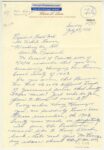
This item also contains prior letters from Lewis to the White House, responses from White House Director Correspondence of Roland Elliott, and Department of State news releases.
OCR Extracted Text
Auto-generated by the National Archives Catalog.
9
Don't give Panama our canal!
Give them Kissinger instead!
cy
CRIT. Kissinger
more imp ?
Claine L. Lewis
File
5328 PARK LANE, SAN Bernardino, CALIFORNIA 92404
GENERAL
c/s-2A
Sunday FG87
July 27,1975
President Gerald Fred.
The White House
W whing ton, DC.
Dear Mr. Presdent:
mr Polaud L. Ellietts letter of
considering changeng for Panama
5/5/75 indicates that you are
Canal Treaty of 1903,
has had 46 or47 different heads
are you aware that Phrama
If government sure who that do Treaty
theas to? you
plan to
Every where They Kissinger
goes - we suddenly house loss.
Please remember, the 1903
Treaty was made in perpetuity
In pure the Russions
would like to have alaska
back 1 Lets not guel Mr Kasing
any ideas about AUG
that or we
61975
CENTRAL FILES
Elaine L. Lewis
5328 PARK LANE, SAN BERNARDINO, CALIFORNIA 92404
might losse our 49 State
more responsibility,
In for less Big government
and with Hads help, a butter
world
I had one of the top 3 telephone
misoul- you Reagon presented
Centers for the Relection of Pels.
me with a Tap Gold Seal
award, One of our sons is in
his fourth term in the Assembly.
about Emery day, the I Communish tell some one
Conspiracy in our great
Country.
Suncerely Exame Lew
FORD LIBRARY & GERALD
GENERAL
F687
of
May 5, 1975
F09
Dear Mrs. X Lewis: Elaine L.
The President has asked that I reply to your letter
of April 3, concerning the Panama Canal treaty
negotiations. Your expression of concern is
appreciated.
You may be assured that the question of United
States interests in the Panama Canal and how we
might best protect them has been subject to the
most thorough review and continues to receive
concerted attention throughout the Executive Branch.
Our principal goal in these negotiations is to protect
United States interests over the long term.
Panama has been dissatisfied with the Treaty of 1903
since its inception and has pressed for more favorable
terms with increasing intensity in recent years. We
believe it should prove possible to negotiate a new
treaty relationship with Panama which will protect
basic United States interests in the Canal (including
provision for the operation and defense of the Canal
by the United States for an extended period of time)
while meeting some of Panama's concerns and desires.
It is our belief that this is of vital importance if we are
to maintain access to the Canal over the long term. The
talks, however, are still continuing and a number of
difficult issues remain to be discussed.
You may be sure that any decision which the President
might make affecting the future of the Canal will protect
United States interests, and any treaty agreed upon by
RECEIVED
MAY 6.1975
FORD LIBRARY is GERALD
CENTRAL FILES
- 2 -
the negotiators would be subject to full constitutional
process, including approval by the Senate.
With the President's best wishes,
Sincerely,
Roland L. Elliott
Director of Correspondence
Mrs. Elaine L. Lewis
5328 Park Lane
San Bernardino, California 92402
RLE:NSC:JHH:RLE:aby
FORD LIBRARY & GERALD
2385
NATIONAL SECURITY COUNCIL
May 1, 1975
MEMO FOR:
JEANNE W. DAVIS
FROM:
STEPHEN LOW
SN
SUBJECT:
Letter to Mrs. Elaine L.
Lewis re Panama Canal
Treaty Negotiations
Attached for your signature is a memo to
Roland Elliott forwarding a suggested reply
to Mrs. Lewis of California re the Panama
Canal Treaty negotiations.
RECEIVED
MAY 9 1975
FORD is LIBRARY 0ERALD
CENTRAL FILES
2385
MEMORANDUM
NATIONAL SECURITY COUNCIL
May 1, 1975
MEMORANDUM FOR:
ROLAND LIOTT
FROM:
JEANNE W. DAVIS
mo
SUBJECT:
Letter to Mrs. Elaine L. Lewis re
Panama Canal Treaty Negotiations
Mrs. Elaine L. Lewis of San Bernadino, California, and mother
of state assemblyman Jerry Lewis, wrote the President April 3 to
express her opposition to relinquishing control over the Canal to
Panama. She asked for a copy of the proposed treaty. (Tab B)
Attached for your signature at Tab A is a suggested letter of
response on behalf of the President. The letter notes that we
believe it will be possible to negotiate a modernized treaty
relationship protecting basic U.S. interests in the operation and
defense of the Canal while meeting some of the Panamanian
concerns and desires. The letter points out that the talks are
continuing and that a number of difficult issues remain to be
discussed. It is also pointed out that any treaty would be subject
to full constitutional process including Senate approval.
Attachments:
Tab A: Suggested response to Mrs. Elaine L. Lewis
Tab B: Incoming
FORD is LIBRARY GERALD
A.
GERALD
FORD LIBRARY &
Suggested Reply
final
Dear Mrs. Lewis:
The President has asked that I reply to your letter of
April 3, 1975, concerning the Panama Canal treaty negotiations.
Your expression of concern is appreciated.
You may be assured that the question of United States
interests in the Panama Canal and how we might best protect them
has been subject to the most thorough review and continues to receive
concerted attention throughout the Executive Branch. Our principal
goal in these negotiations is to protect United States interests over
the long term.
Panama has been dissatisfied with the Treaty of 1903 since
its inception and has pressed for more favorable terms with
increasing intensity in recent years. We believe it should prove
possible to negotiate a new treaty relationship with Panama which
will protect basic United States interests in the Canal (including
provision for the operation and defense of the Canal by the United
States for an extended period of time) while meeting some of Panama's
concerns and desires. It is our belief that this is of vital importance
if we are to maintain access to the Canal over the long term. The
talks, however, are still continuing and a number of difficult issues
remain to be discussed.
(continued)
FORD in LIBRARY GERALD
You may be some that
Any decision which the President might make affecting the
future of the Canal will protect United States interests, and any
treaty agreed upon by the negotiators would be subject to full
constitutional process, including approval by the Senate.
with the Pres's best mile,
Sincerely,
R LE
Mrs. Elaine L. Lewis
5328 Park Lane
San Bernardino, California 92404
RLE/NSC/JA
TUNE & GERALD LIBRARY
UNCLASSIFIED
(CLASSIE ICATION)
DEPARTMENT OF STATE
S/S: 7507484
EXECUTIVE SECRETARIAT
TRANSMITTAL FORM
Date: April 22, 1975
For: Lt. Gen. Brent Scowcroft
National Security Council
The White House
Pursuant to referral dated April 15, 1975 , NSC No. 7502385 (if any)
a copy of which is attached, we are enclosing the following:
Information copy
of direct reply
Translation
Other
XX
Draft reply for:
President's signature
XX
Other signature
We believe no response is necessary for the reason cited below
The attached item, which was sent directly to the Department
of State, is being forwarded for your attention.
We believe no response is necessary for the reason cited below
A draft reply is attached
A draft reply will be forwarded
A translation is attached
Other
REMARKS:
DOCUMENT DESCRIPTION:
To:
President Ford
From: Elaine L. Lewis
Date: April 3, 1975
Subject: Panama Canal Treaty Negotiations
Pulil Bloods
(for)
George S. Springsteen
Executive Secretary
FORD LIBRARY & GERALD
SUGGESTED REPLY
Dear Ms. Lewis:
President Ford has asked that I reply to your letter
of April 3 concerning the Panama Canal treaty negotiations.
You may be assured that the question of United States
interests in the Panama Canal and how we might best pro-
tect them has been subject to the most thorough review and
continues to receive concerted attention throughout the
Executive Branch. Our principal goal in these negotiations
is to protect U.S. interests.
Panama has been discontented with the Treaty of 1903
since its inception and has pressed for more favorable terms
with increasing intensity in recent years. Treaty revisions
were made in 1936 and 1955. But the most objectionable
feature from Panama's viewpoint -- United States exercise
of rights as if sovereign in the Canal Zone in perpetuity --
remained unchanged. The Canal has become the major political
issue in Panama as well as a continuing source of tension
in U.S. - -Panamanian relations. A flag raising incident in
the Canal Zone in 1964 led to riots and the death of 20
Panamanians and 4 Americans.
Ms. Elaine L. Lewis,
5328 Park Lane,
San Bernardino, California 92404
FORD LIBRARY is GERALD
- 2 -
After considering all the factors, and recognizing
that a disgruntled and resentful government and people in
Panama could create a situation in which United States in-
terests in the Canal would be seriously threatened, the re-
sumption of treaty negotiations with Panama was undertaken.
The negotiations began in June 1971 and have been renewed
under a new U.S. chief negotiator, Ambassador at Large Ellsworth
Bunker.
Primary United States objectives in the negotiations
are: the right to administer, operate and defend the Canal
for an extended period of time; an option to expand capacity,
either by adding a third set of locks or building a new
sea-level canal; and most importantly, a viable treaty ar-
rangement which provides the basis for an enduring, mutually
acceptable relationship with Panama.
As in all negotiations both sides have put forth po-
sitions. Many issues remain to be resolved and negotiations
are continuing. We cannot predict when an agreement on
a new treaty will be reached.
Any decision which the President might make affecting
the future of the Canal will, of course, protect United
States interests. In fact, a major reason for initiating
these negotiations is to head off a crisis which would en-
danger those interests. A treaty, of course, would be sub-
mitted to the Senate for approval and would be subject to
full constitutional process.
FORD LIBRARY & GERALD
- 3 -
Information concerning the issues involved in the
Canal treaty negotiations is contained in the enclosed copy
of the Background and Status of the Panama Canal Treaty
Negotiations prepared by the Office of Panamanian Affairs.
Also enclosed is a copy of a speech by Ambassador Bunker
on the treaty issue.
I hope you will call on me if we can be of further
assistance.
Sincerely,
FORD LIBRARY i GERALD
THE DEPARTMENT
CONUNS
OF STATE
News Release:
January 1975
Bureau of Public Affairs
Office of Media Services
PANAMA CANAL TREATY NEGOTIATIONS:
BACKGROUND AND CURRENT STATUS
GERALD FORD LIBRARY
Background
Canal, rearrangement of markets and sources,
product exchanges, and partial or complete sub-
The United States and Panama are currently
stitution of land or air transport for ocean trans-
negotiating a new Panama Canal treaty to replace
port. As canal users take advantage of these
the Treaty of 1903.
alternatives, the canal's value declines relative to
In that treaty Panama granted the United
the economies of the user nations. For the
States-in perpetuity-the use of a 10-mile wide
United States, in particular, a recent study has
zone of Panamanian territory for the "construc-
shown that the canal's impact on the domestic
tion, maintenance, operation and protection" of
economy is quite small compared to the economy
a canal, as well as all the rights, power, and
as a whole.
authority within that zone which the United
States would "possess if it were the sovereign."
Panamanian Treaty Concerns
The very favorable terms of the treaty were a
major factor in the U.S. decision to build the
Panama has been dissatisfied with the treaty for
canal in Panama rather than in Nicaragua as
many years. Part of this dissatisfaction has de-
initially planned.
rived from Panama's interpretation of two aspects
of the situation which resulted in the Treaty of
Canal's Economic Value
1903: (1) Panama's acceptance of unfavorable
treaty terms due to its dependence upon the
Since its opening in 1914, the canal has pro-
United States to protect its new-found indepen-
vided benefits to the United States, to Panama,
dence from Colombia; and (2) Panama's principal
and to the world. Of the total tonnage that
negotiator was a Frenchman who benefited
transits the canal, about 44 percent originates in,
considerably when the United States purchased
and 22 percent is destined for, U.S. ports. This
the private French concession to build a trans-
tonnage represents about 16 percent of the total
isthmian canal.
U.S. export and import tonnages.
Over the years Panama has also charged that
The canal has been economically important to
the United States has unilaterally interpreted the
Panama, too. More than 30 percent of Panama's
treaty to Panama's disadvantage and given Panama
foreign exchange earnings and nearly 13 percent
an inadequate share of the benefits from the op-
of its GNP are directly or indirectly attributed to
eration of the waterway. Even more objection-
the presence of the canal. But those contribu-
able in Panama's view, are the provisions in the
tions represent a smaller portion of Panama's
Treaty of 1903 which give to a foreign power in
economy now than they did in years past.
perpetuity governmental jurisdiction within a
In fact, reliance on the canal by all parties has
portion of Panamanian territory. Increasingly in
evolved from earlier years. As trading patterns
recent years Panama has insisted that U.S. control
have changed and world commerce has become
over the Canal Zone prevents the country from
more sophisticated, alternatives to the canal have
realizing its full economic potential.
begun to emerge. These alternatives include the
The United States has responded sympathet-
use of larger vessels which would bypass the
ically to some of these Panamanian concerns. In
2
3
1905 it recognized Panama's titular sovereignty
President Nixon established negotiating objectives
served as a useful framework for the present
the United States require to accomplish its
over the Canal Zone. The treaty was revised in
which, although modified by developments, were
negotiations.
purpose?
1936, and again in 1955, to provide Panama
similar to those set by President Johnson in 1964.
3. Jurisdiction: What areas will be controlled
with a greater share of the economic benefits of
The objectives and positions of the United States
U.S. Treaty Objective
and what functions will be exercised by the
the canal and to remove certain outdated aspects,
thus reflect a bipartisan approach to treaty nego-
United States when its jurisdiction terminates,
such as the right granted to the United States to
tiations with Panama. They also are consistent
The principal objective of the United States
and what is the period of transition?
interfere, when it believed necessary, in Panama's
with the broader policy stated in Secretary
in the current treaty negotiations is to protect
4. Expansion of Capacity: How will the
internal affairs. Despite these modifications, how-
Kissinger's call in October 1973 for a "new dia-
our basic interests in the Panama Canal. The
treaty provide for possible enlargement of canal
ever, many of the features of the treaty most
logue" with our Latin American neighbors, a
U.S. Government is seeking to establish a new and
capacity?
objectionable to Panama remain unchanged.
policy which President Ford has publicly endorsed.
mutually acceptable relationship between our
5. Participation: How and to what extent
The canal has become the major political issue
A Panamanian negotiating team arrived in
two countries whereby the United States will re-
will Panama participate in the administration and
in Panama. In recent years the intensification of
Washington in June 1971. Intensive negotiations
tain essential rights to continue operating and
defense of the canal?
Panama's campaign for more favorable treaty
during the rest of the year resulted in a U.S.
defending the canal for a reasonably extended
6. Compensation: What will be the form and
terms has produced tensions in U.S.-Panamanian
treaty offer covering most of the issues relevant
period of time. A new treaty based on partner-
level of economic benefits to Panama in any new
relations. In 1964 the death of 20 Panamanians
to the treaty. The Panamanian negotiators carried
ship with Panama would enable the United States
treaty?
and 4 Americans brought the Panama Canal issue
the offer to Panama for a review in December
to devote all its energies to the efficient operation
to the attention of the United Nations and the
1971. Except for some informal conversations in
of the waterway. Moreover, it would provide a
Current Status of Negotiations
Organization of American States (OAS).
March 1972 and an exchange of correspondence
friendly environment in Panama that is most con-
in the fall, the negotiations were not resumed
ducive to protecting our vital interests in keeping
Since June 1974, the talks have been taking
Evaluation of Bilateral Negotiations for a New
until December 1972, when a U.S. delegation
the canal open and secure. Such a treaty would
place in a cordial, informal atmosphere. The
Treaty
traveled to Panama.
be consistent with good business management,
U.S. negotiators have been proceeding carefully
represent good foreign and defense policy, and
and methodically. While there is no fixed time-
Following discussion of the issue by the OAS,
U.S. Security Council Action
signify a new era of cooperation between the
table, the negotiators from both countries have
the United Nations, and other international agen-
United States and the rest of the hemisphere.
indicated their satisfaction with the progress to
cies after the 1964 riots, the United States and
At Panama's initiative, the U.N. Security
In recent years Latin American nations have
date and are hopeful that both countries can
Panama agreed in 1964 to begin bilateral negotia-
Council met in Panama City from March 15 to
made the negotiation of a more equitable canal
reach agreement on a draft treaty.
tions for a new treaty. In so doing, the United
March 21, 1973. In those sessions, Panama criti-
treaty with Panama a major hemispheric issue
Any decision which the President might make
States recognized that a comprehensive moderni-
cized the U.S. posture on the canal question and
and a test of U.S. intentions regarding the "new
affecting the future of the canal will, of course,
zation of its relationship with Panama correspond-
sought a resolution supporting its position. Thir-
dialogue."
be designed to protect U.S. interests. Indeed, a
ed to its long-term national interests and to a
teen nations voted for the resolution; the United
major reason for negotiating a new treaty is to
changing international environment.
Kingdom abstained. The United States vetoed
Issues in the Negotiations
avert a serious crisis which would endanger our
U.S. officials entered the negotiations in late
the resolution on the grounds that it recognized
interests.
1964 with a view to insuring that:
Panama's needs but not those of the United
In the months following the February 7 signing
Any treaty agreed upon by the negotiators and
The canal should continue to be available to
States; that it was incomplete in its references to
of the Statement of Principles, Ambassador
approved by the executive branch will be submit-
the world's commercial vessels on an equal
the negotiations; and that it was inappropriate
Bunker and Foreign Minister Tack met several
ted to the U.S. Senate for ratification and subject
basis at reasonable tolls;
because the treaty was a bilateral matter under
times in Panama and Washington to define the
to full constitutional process. Panama, for its
It should be operated and defended by the
amicable negotiations. In explaining the U.S.
issues involved in the new treaty arrangement.
part, has said that it will submit the new treaty
United States for a reasonably extended, but
position, the U.S. Permanent Representative com-
After agreement was reached, the negotiators
to a plebiscite to insure that it is acceptable to
definite, period of time; and
mitted the United States to peaceful adjustment
moved into substantive talks aimed at resolving
the Panamanian people.
It should continue to serve world commerce
of its differences with Panama and invited
these issues.
efficiently. To this end, the United States
Panama to continue serious treaty negotiations.
The United States and Panama have agreed in
sought the right to provide additional canal
principle that the Treaty of 1903 should be re-
capacity if it is needed.
New U.S. Approach
placed by a modern treaty that rejects the concept
By 1967, the negotiators of both countries had
of perpetuity and accommodates the sovereignty
STATEMENT OF PRINCIPLES
prepared three draft treaties. They provided for
In September 1973 Secretary Kissinger charged
of Panama with the interests of the United States,
operation of the present canal under a joint U.S.-
Ambassador at Large Ellsworth Bunker with the
on the understanding that U.S. control and de-
Joint Statement by the Honorable Henry A.
Panamanian authority; for construction and op-
task of renewing discussions with Panamanian
fense of the Panama Canal would continue for a
Kissinger, Secretary of State of the United
eration of a sea-level canal under a similar joint
officials for the purpose of arriving at a common
period of fixed duration. In the context of the
States of America, and His Excellency Juan
authority; and for U.S. defense of the old and
approach to future treaty negotiations. Ambas-
Statement of Principles the issues the two nego-
Antonio Tack, Minister of Foreign Affairs of
new canals for the duration of each treaty. Nei-
sador Bunker visited Panama from November 26
tiating parties are working to resolve are:
the Republic of Panama, on February 7, 1974
ther Panama nor the U.S. Government moved to
to December 3, 1973, and again on January 6
1. Duration: How long will the new treaty
at Panama
ratify these treaties, and the new government
and 7, 1974, to discuss with Panamanian Foreign
remain in force?
headed by General Omar Torrijos, which assumed
Minister Juan Antonio Tack general principles
2. Operation and Defense: What rights and
The United States of America and the Repub-
power in October 1968, formally rejected them.
upon which a new treaty might be based. These
arrangements will the United States have to
lic of Panama have been engaged in negotiations
In 1970 the Government of Panama requested
discussions resulted in the Statement of Principles
permit it to continue to operate, maintain, and
to conclude an entirely new treaty respecting
the renewal of negotiations and the U.S. agreed.
of February 7, 1974 (See p. 3), which has
defend the canal? What geographic areas will
the Panama Canal, negotiations which were made
4
possible by the Joint Declaration between the
dance with what that treaty states, the right to
two countries of April 3, 1964, agreed to under
use the lands, waters and airspace which may be
the auspices of the Permanent Council of the
necessary for the operation, maintenance, protec-
Organization of American States acting provision-
tion and defense of the canal and the transit of
ally as the Organ of Consultation. The new
ships.
treaty would abrogate the treaty existing since
5. The Republic of Panama shall have a just
1903 and its subsequent amendments, establish-
and equitable share of the benefits derived from
ing the necessary conditions for a modern rela-
the operation of the canal in its territory. It is
tionship between the two countries based on the
recognized that the geographic position of its
most profound mutual respect.
territory constitutes the principal resource of the
Since the end of last November, the authorized
Republic of Panama.
representatives of the two governments have been
6. The Republic of Panama shall participate
holding important conversations which have per-
in the administration of the canal, in accordance
mitted agreement to be reached on a set of fun-
with a procedure to be agreed upon in the treaty.
damental principles which will serve to guide the
The treaty shall also provide that Panama will
negotiators in the effort to conclude a just and
assume total responsibility for the operation of
equitable treaty eliminating, once and for all, the
the canal upon the termination of the treaty. The
causes of conflict between the two countries.
Republic of Panama shall grant to the United
The principles to which we have agreed, on
States of America the rights necessary to regulate
behalf of our respective governments, are as
the transit of ships through the canal and operate,
follows:
maintain, protect and defend the canal, and to
undertake any other specific activity related to
1. The treaty of 1903 and its amendments
those ends, as may be agreed upon in the treaty.
will be abrogated by the conclusion of an entirely
7. The Republic of Panama shall participate
new interoceanic canal treaty.
with the United States of America in the pro-
2. The concept of perpetuity will be eliminated.
tection and defense of the canal in accordance
The new treaty concerning the lock canal shall
with what is agreed upon in the new treaty.
have a fixed termination date.
8. The United States of America and the
3. Termination of United States jurisdiction
Republic of Panama, recognizing the important
over Panamanian territory shall take place prompt-
services rendered by the interoceanic Panama
ly in accordance with terms specified in the treaty.
Canal to international maritime traffic, and bear-
4. The Panamanian territory in which the canal
ing in mind the possibility that the present canal
is situated shall be returned to the jurisdiction of
could become inadequate for said traffic, shall
the Republic of Panama. The Republic of Panama,
agree bilaterally on provisions for new projects
in its capacity as territorial sovereign, shall grant
which will enlarge canal capacity. Such provi-
to the United States of America, for the duration
sions will be incorporated in the new treaty in ac-
of the new interoceanic canal treaty and in accor-
cord with the concepts established in principle 2.
DEPARTMENT OF STATE, U.S.A.
POSTAGE AND FEES PAID
DEPARTMENT OF STATE
WASHINGTON, D.C. 20520
STA-501
U.S.MAIL
THIRD CLASS
BULK RT.
FORD
GERALD
LIBRARY
NEWS
BUREAU OF PUBLIC
RELEASE
Department of State
Office of Media Services
STATES
OF
Speech Text:
AMBASSADOR BUNKER ON THE
FOR IMMEDIATE RELEASE
PANAMA CANAL TREATY NEGOTIATIONS
April 1, 1974
Address by Ambassador at Large
Ellsworth Bunker, Chief U.S. Negotiator
for the Panama Canal Treaty, before the
Center for Inter-American Relations,
March 19, 1974, New York City, N.Y.
The reason that I am particularly pleased to be with you is that I could
hardly hope for a better audience before which to venture my first public
thoughts on the matter of a new treaty relationship between the United States
of America and the Republic of Panama.
This audience will understand that because the new relationship is a
matter of transcendence for the two countries - and, in some measure, for the
whole hemisphere and the world community - it is one which demands the constant
application by both governments of:
-- Reason rather than emotion;
-- New ideas rather than old memories; and
-- The will to accommodate rather than the wish to confront.
All that makes it quite a difficult matter, possibly the most difficult I
have yet addressed as a negotiator.
I should like you to have the background of it, then the foreground as I
can perceive it.
Background
We start from a treaty that is 70 years old. In 1903 the newly-independent
Republic of Panama granted to the United States -- in perpetuity -- the use of
a strip of land ten miles wide and 50 miles long for the construction,
maintenance, operation, and protection of a canal between the Atlantic and the
Pacific.
Panama also granted to the United States all the rights, power, and
authority to act within that strip of land as "if it were the sovereign."
That the treaty favored the United States was acknowledged promptly.
John Hay, then Secretary of State, told the Senate, in submitting it for
ratification:
"
We shall have a treaty very satisfactory, vastly advantageous to the
United States and, we must confess not so advantageous to Panama."
FORD LIBRARY & GERALD
- 2 -
To be sure, had the United States not been offered so advantageous a
treaty by Panama, it might well have built the canal elsewhere.
Urmistakably, the construction of that waterway was an astounding
achievement. Consider the triumph over tropical diseases; the gigantic
engineering effort; the participation of people of many races and lands --
these are sources of extraordinary pride to our people.
Canal Benefits
We are no less proud of what the canal has represented since it opened.
It has spurred the creation of major new international markets. It has caused
the creation of entirely new sea routes. It has saved seafaring nations
countless sums in terms of time, energy, and money. These -- together with the
safe, efficient, and inexpensive operation of the waterway -- have provided
Panama, the United States, and the entire world with benefits which obviously
have been of incalculable value.
Let me illustrate some of the benefits to Panama:
-- One-fourth of that country's gross national product in recent years has
been directly or indirectly attributable to the operation of the canal and the
military bases within it;
-- More than one-third of Panama's total foreign exchange earnings in
recent years has derived from United States payments for Panamanian goods and
services used in the Zone;
-- Perhaps as much as one-fifth of Panama's employment nationwide is
directly or indirectly attributable to the presence of the canal;
-- Panama has become a crossroads of the hemisphere, a center for banking,
shipping, transport, and communications, and it has prospects for accelerated
development in the years to come.
Today, that country's per capita income is the highest in Central America,
the fourth highest in Latin America as a whole, exceeded only by that of
Argentina, Uruguay, and Venezuela.
For the United States, the benefits have been military as well as economic.
It was the 7,000-mile, 66-day voyage of the US battleship "Oregon" around
Cape Horn during the Spanish-American War that led us to build a trans-isthmian
waterway. And its military value to the United States has not diminished,
although it has changed.
Its strategic importance was demonstrated:
-- When the Japanese attack on Pearl Harbor left the United States without
significant naval strength in the Pacific. Redeployment of elements of the
Atlantic fleet through the canal saved more than two weeks steaming time
around the Capes.
-- When during the Cuban missile crisis of 1962 mobilization orders found
nearly all landing craft concentrated on the West Coast. More than 60 military
vessels were redeployed to Gulf and East Coast ports in less than 10 days.
Even today, when major elements of our defense system are intercontinental
bombers and missiles, the canal remains a vital line of communication. Despite
limitations on the size of vessels which can pass through it, it permits
the majority of US Navy ships to move expeditiously between oceans. Perhaps
more important, it shortens supply lines from the United States to potential
trouble spots around the world.
GERALD FORD LIBRARY
- 3 -
The Viet-Nam conflict, necessitating a rapid buildup of men and material
in Southeast Asia during the mid-60's, is the most recent example of the
logistical role the canal plays for the United States. Because our production
capacity is located mostly east of the Mississippi River and our internal
transportation was insufficient, we were forced to depend heavily on the Canal
to transport equipment and supplies to our forces.
As for economic benefits to this country, they have unquestionably been
great in the past. But how great they are today is relative. For example,
it is true that 16 percent of the US ocean-borne trade passes through the Canal.
It is also true, however, that our total foreign trade accounts for something
less than ten percent of this country's gross national product.
Indeed, there are those who argue that the value of the United States to
the Panama Canal far exceeds the value of the Panama Canal to the United States.
The argument derives from the fact that some 70 percent of the traffic through
the canal is either bound for, or coming from, this country.
Whatever the statistics, however, we know intuitively that the waterway
contributes importantly to the economic well-being of our people.
US Role in Canal Zone
Where do the critical interests of our country now lie, and how may they
best be served?
I suggest that they lie in the continued operation and defense of the
canal by the United States for a further and reasonably extended period of time.
May I also suggest, however, that we can serve those interests adequately
only if we move to change -- to modernize -- the nature of the presence of the
United States in the Canal Zone.
It is a quite uncommon presence. Some 40,000 American citizens live and
work in a 500-square mile area very much as they might live and work in any
area of 500 square miles in the continental United States.
When all is said and done, however, that presence rests upon the consent
of the Panamanian people.
That is so because, were the level of consent to decline to zero, but our
presence remain, we would find ourselves in the position of engaging in
hostilities with the people of an otherwise friendly American state, on its soil.
If I do not misread the temper of the American people and the times, that
position would be unacceptable.
So long as the consent of Panama to our presence remains at a high level,
the United States can devote all its energies there to the functions required
for the efficient operation of the waterway. But in proportion as the consent-
level declines, in that proportion we must divert some of our energies to
functions not related directly to the waterway's operation. And in that
proportion the efficiency of the operation declines to. the detriment of our
critical interests.
Panama's Attitude
For many years the level of Panama's consent has persistently declined.
And by Panama, I mean the Panamanian people, of all strata, not simply
their government. Governments in Panama may change.
FORD
- 4 -
But I am persuaded that governmental change will never again divert the
Panamanian people from the course of legitimate nationalism they are now
pursuing.
Unfortunately I must say that I consider the current level of consent to
be unacceptably low. It began to be so ten years ago, when events in the
Canal Zone led to rioting that occasioned 24 American and Panamanian fatalities.
Why has it declined? The Panamanians cite the following:
-- The United States occupies a 10-mile wide strip across the heartland
of Panama's territory, cutting the nation in two, curbing the natural growth
of its urban areas.
The United States rules as sovereign over this piece of Panama's
territory. It maintains a police force, courts, and jails to enforce US laws,
not only upon American but also upon Panamanian citizens.
-- The US Government operates virtually all commercial enterprises within
the Zone, denying to Panama the jurisdictional rights which would enable its
private enterprise to compete.
-- The United States controls virtually all of the deep-water port
facilities serving Panama.
-- The United States holds, unused, large areas of land within the Zone.
-- The United States pays Panama but $2 million annually for the immensely
valuable rights it enjoys on Panamanian territory.
-- The United States operates, on Panamanian territory, a full-fledged
government that has no reference to the Government of Panama, which is its host.
-- The United States can do all these things, the treaty states, forever.
To these things the Panamanians object, saying that they deprive their
country of dignity, of the ability to develop naturally, and, indeed, of full
independence.
One could disagree. One could ask that Panama relax in the tropics and
enjoy, perpetually, the enormous direct and indirect benefits which the operation
of the canal in its territory by the United States has brought to it. Yet the
level of consent would not thereby be raised.
One can more usefully ask: What is the nature of these things to which
Panama objects? Close scrutiny indicates, I suggest, that they resemble the
appurtenances of power rather than power itself that it is the manner of the
United States presence in Panama, not the presence itself, which is at the heart
of our problem with that country -- and, I must add, with the world community.
My impression is that the United States would do well to examine what there
is about our presence in the Canal Zone that is essential to our critical
interests, and what is not, and then proceed to modify the latter so that we
may protect the former.
The process will not be easy, for either country. On one hand, the
physical, legal, and psychological architecture which the United States has
erected in this 500 square miles over many years is enormous, and very solid.
On the other, Panama's capacity to absorb, to rebuild, to redesign, is limited.
But there really is no rational alternative.
- 5 -
Negotiating Efforts
For more than ten years we have been engaged with Panama, determined to
arrive at a new and modernized relationship which could cause Panamanians to be
fully content that the United States remain in Panama -- and Americans to be
fully content to remain there. Successive American Presidents since Dwight
Eisenhower have pressed that negotiation.
If our negotiations have not prospered over so many years, it is not for
lack of distinguished and dedicated Panamanians and Americans negotiating.
Rather it is because the times have simply not been right.
In any case, what is negotiating past is not negotiating prologue.
When Secretary of State Kissinger and I had the pleasure of meeting for
the first time with the Foreign Minister of Panama in New York October 1973,
the Secretary suggested that henceforth in this negotiation the United States
should not attempt to impose its will on Panama, nor Panama attempt to impose
its will on the United States.
And I am able to say, after four months of the new negotiation, that the
negotiators on both sides have accepted that counsel. Political decisions have
been taken to make accommodation a way of negotiating life. We shall not, I
think, be easily distracted from it.
Statement of Principles February 7, 1974
The world has already observed that accommodation. In February the
Secretary of State journeyed to Panama to initial with the Panamanian Foreign
Minister a set of eight "Principles." They are to serve as guidelines for the
negotiators in working our the details of a new treaty.
Perhaps the chief of government of Panama best characterized these
principles when he said they constituted a "philosophy of understanding.'
Their essence is that:
-- Panama will grant the United States the rights and facilities and lands
necessary to continue operating and defending the Canal;
-- The United States will agree to return to Panama jurisdiction over its
territory; to recompense Panama fairly for the use of its territory; and to
arrange for the participation by Panama, over time, in the canal's operation
and defense.
It has also been agreed in the "Principles" that the new treaty shall not
be in perpetuity, but rather for a fixed period, and that the parties will
provide for any expansion of canal capacity in Panama that may eventually be
needed.
Beginning of Modernization Process
Still another form of accommodation will, I trust, be visible shortly.
Following my first visit to Panama, I recommended to the President that the
United States should not await the successful conclusion of treaty negotiations
to begin modernizing its presence in the Canal Zone, to the benefit of both
countries. He agreed, and is now forwarding to the Congress legislation which
would return to Panama two World War II airfields now within the Canal Zone,
which Panama could put to very good use for economic development. I am hopeful
the Congress will agree that this is only "right" for the United States to do.
GERALD
- 6 -
It escapes neither of the two negotiating parties that these accommodations
are but a good beginning. A treaty arrangement which has evolved over 70 years,
and evolved too often in acrimony rather than harmony, will not yield readily to the
skills of negotiators, nor even to the political dictates of heads of government.
Nor does it escape the parties that there is opposition in both their
lands. In this country there are those who hold that it is folly for the
United States to alter the nature of its presence in the Canal Zone by making
any concessions to Panama, and that our power must reside there, undiluted,
forever. In Panama there are those who hold that it is folly to make a
single concession to the United States, and that its presence must be eliminated
forthwith.
We can acknowledge the profound patriotism of those views. Were the
executive authorities of the two countries to share them, however, they would
be sqaurely on a collision course.
The plain fact of the matter is that geography, history, and the economic
and political imperatives of our times compel the United States and Panama to
have a joint stake in the Panama Canal enterprise. It follows that with
respect to that enterprise they should comport themselves as partners, and
friends -- preserving what is essential to each, protecting and making ever
more efficient a vital international line of communication, and, I suggest to
you, creating a model for the world to admire of how a small nation and a large
one can work peacefully and profitably together.
I think that is not too grand a design.
UNT.
CLASSIFICATION
NSC REFERRAL TO STATE SECRETARIAT
Date: April 15, 1975
MEMORANDUM FOR:
GEORGE SPRINGSTEEN
NSC LOG# 7502385
EXECUTIVE SECRETARY
DEPARTMENT OF STATE
DOCUMENT DESCRIPTION:
TO: President Fort
FROM: Elaine L. Lewis
DATE: April 3, 1975
SUBJECT: Concern over proposed new panama canal treaty
ACTION REQUESTED:
XXXX DRAFT REPLY FOR:
PRESIDENT'S SIGNATURE
XXXWHITE HOUSE STAFF SIGNATURE
OTHER
DIRECT REPLY
FURNISH INFO COPY
DISPATCH
RECOMMENDATIONS/COMMENTS
TRANSLATION
APPROPRIATE HANDLING
INFORMATION
FOR ADDITIONAL PROCESSING AS INDICATED:
DUE DATE:
URGENT
ROUTINE XXXX
due by April 22nd
COMMENTS:
for JEANNE W. DAVIS
Staff Secretary
JNh
GERALD FORDI IBRARY
CLASSIFICATION
17
Stop
Elaine L. Lewis
2385
5328 Park Lane
San Bernardino, California 92404
HK Prio Ms Gerald Fard
apr 1975
The Whitehouse
R.FORD LIBRARK
Washington, DC.
Dear Mr. President:
I waul like a copy of the
purposed Panama Canal Treaty.
I am very influential in
California Politics.
State assemblyman, considered
Our son, Jury Lewis is a
to he the most powerful
Republican in the assembly.
Iam unalturably apposed
our Parcome Canal to the
to releasing any Control only
unstable Panama Government
To do so would he treason
Suncerely Elaine Lewl
DOC
RECD
LOG NBR
INITIAL ACTION 0
NSC CORRESH ONDENCE PROFILE
MO
DA
MO
DA
HR
42
415/6
7502385
LEWIS ELaine L
REFERENCE:
CIRCLE AS APPROPRIATE
X
TO: PRES
FROM: KISSINGER,
s/s
UNCLAS LOG IN/OUT
KISSINGER
COLBY, W
OTHER
LOU
NO FORN
SOURCE/CLASS/DESCRIPTION
NODIS
SCOWCROFT
SCHLESINGER, J
C
EYES ONLY EXDIS
DAVIS
ST EX SEC
S
CODEWORD
SUBJECT: Treaty Concern Onew Proposed Am Panama TS SENSITIVE Smal
INTERNAL ROUTING AND DISTRIBUTION
REC
ACTION REQUIRED
ACTION
INFO
CY
ADVANCE CYS TO HAK/SCOWCROFT
FOR
MEMO FOR HAK
(
)
STAFF SECRETARY
MEMO FOR PRES
(
)
REPLY FOR
FAR EAST
(
)
SUB-SAHARAN AFRICA
APPROPRIATE ACTION
(
)
DISTRIBUTION/INITIAL ACTION ASGMT
MID EAST / NO. AFRICA / so. ASIA
MEMO
TO
(
)
RECOMMENDATIONS
(
EUROPE / CANADA
)
LATIN AMERICA
X
*
JOINT MEMO
(
)
UNITED NATIONS
REFER TO
FOR:
(
)
ECONOMIC
ANY ACTION NECESSARY?
(
)
SCIENTIFIC
CONCURRENCE
(
)
PROGRAM ANALYSIS
DUE DATE:
NSC PLANNING
COMMENTS: (INCLUDING SPECIAL INSTRUCTIONS)
CONGRESSIONAL
OCEANS POLICY
INTELLIGENCE
DATE
FROM
TO
S
SUBSEQUENT ACTION REQUIRED (OR TAKEN):
CY TO
4/15
State
Draft uph for W. Signature
428
4/22
Reed state durt 75074 84
SUBSEQUENT ROUTING/ACTIONS
4/22
low
S
Memo DAVIS to Ellott (5/01)
5/1
Low
&
c Memo to Elliott
5/2
C
Davis sgd memo to Elliott
5/4/25
DISPATCH
CY RQMTS: SEE ABOVE PLUS:
NSC/S DISP INSTR
NOTIFY
& DATE
BY
M/F'D
MICROFILM & FILE Shin RQMTS:
_BY_
SPECIAL DISPOSITION:
SA
SF
CROSS REF W/
SUSPENSE CY ATTACHED:
June
FOLDER:
FORD & LIBRARY GERALD
OPEN CRT TH ID:
HP
NS
CLOSE
Jf
WH
EP
PA
DY
(NBC-74-21)
Collection GRF-0056
White House Central Files Subject Files (Ford Administration)
1974 – 1977
Series
White House Central Files Subject Files on Federal Government (Organizations)
1974 – 1977
FileUnit
FG 87: Panama Canal Zone Government