
Pages
(4)
Page 1
Page 2
Page 3
Page 4
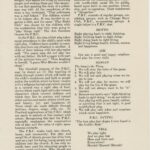
OCR Extracted Text
Auto-generated by the National Archives Catalog.
acad
6/4/29
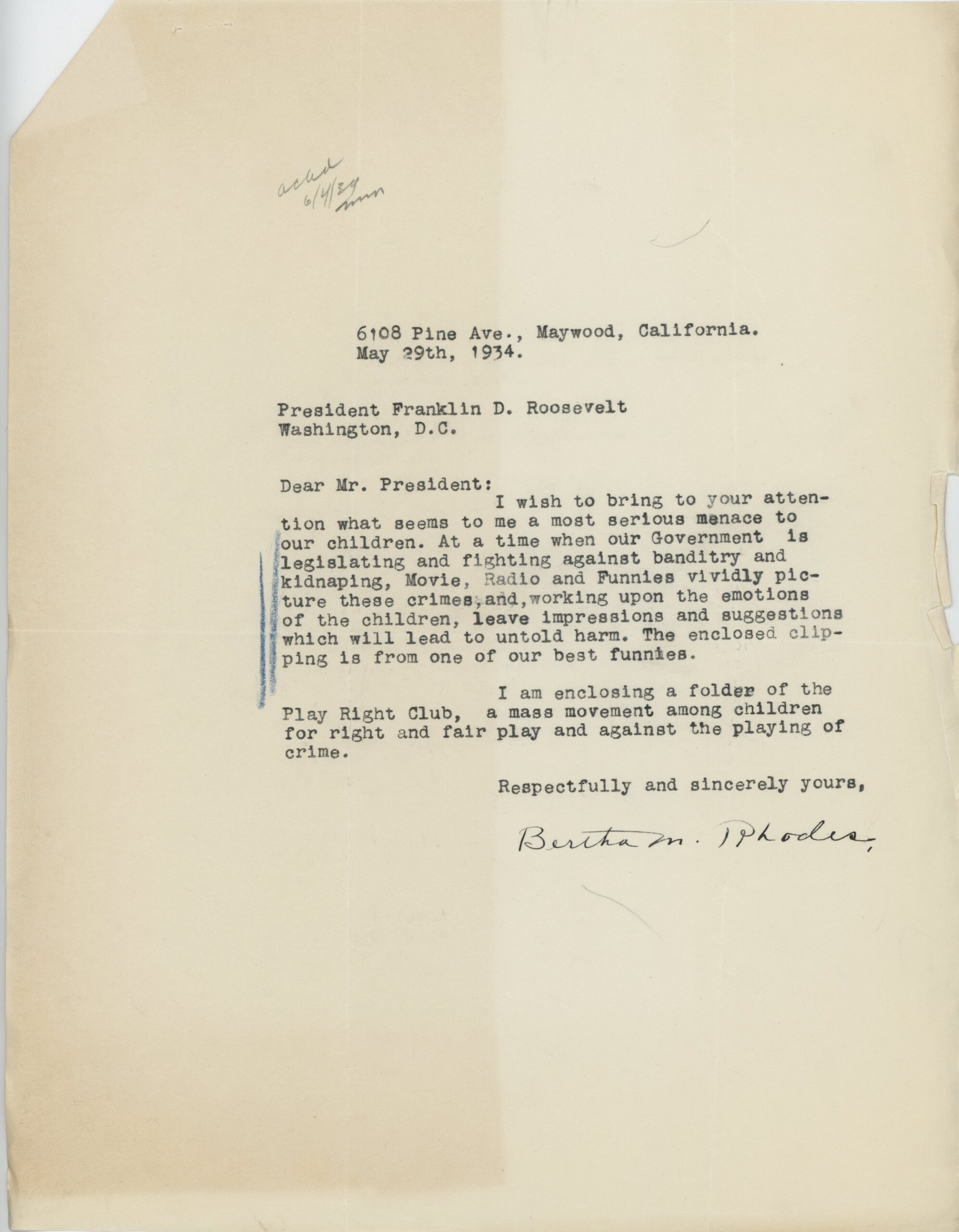
6108 Pine Ave., Maywood, California.
May 29th, 1934.
President Franklin D. Roosevelt
Washington, D.C.
Dear Mr. President:
I wish to bring to your atten-
tion what seems to me a most serious menace to
our children. At a time when our Government is
legislating and fighting against banditry and
kidnaping, Movie, Radio and Funnies vividly pic-
ture these crimes, and, working upon the emotions
of the children, leave impressions and suggestions
which will lead to untold harm. The enclosed clip-
ping is from one of our best funnies.
I am enclosing a folder of the
Play Right Club, a mass movement among children
for right and fair play and against the playing of
crime.
Respectfully and sincerely yours,
Bertha m. Phodes
Zos Angeles Times
MAY 28, 1934.-[PART П.] 11
GASOLINE ALLEY
Propositioned
By King
HAVEN'T
NOT A THING,
DOGNAPPED
YOU
GOOTCH, SINCE
YOU MEAN.
IT'S A
IF U WANT 2 GET YOUR
HEARD
CORKY SAW HIM
LOOK!
NOTE OR
DOG PAL BACK ALIVE
ANYTHING
BEIN' KIDNAPPED.
WHAT'S
A MESSAGE
PUT $2.50 IN A TIN CAN
OF PAL
THAT?
OR SOMETHING.
UNDER THE SHACK BY
YET,
WED. NITE.
SKEEZIX!
Sali
King-
6-29
Reg. U.S. Pat. Off. Copyright, 1934,
by The Chicago Tribune.
PLAY RIGHT CLUB
UCH is being done these days to
played circus, band, school. He expended
M
promote playgrounds, vacation
his energy sliding down the hay mow,
outings, and improved condi-
skating, hiking, fishing. Wide spaces and
tions on the streets where the
freedom were his. Today the child in the
average city child necessarily spends many
city has practically no place for free ac-
hours. But even with these great im-
tivity. He must consider windows, cars,
provements in physical surroundings, the
autos, lawns, unsympathetic landlords,
fact is unescapable that this is only a
and the policeman. Under these changed
part of the play problem of today. This
conditions children still reproduce their
is the external side. The P.R.C. (Play-
environment as they perceive it. And
Right Club) approaches the need of both
what is it they see? Movies picture crime;
the child and the city from another view-
newspaper headlines announce more
point. The ideals and the spirit of P.R.C.
crime; but yesterday the radio was broad-
are furnishing better children for the play-
casting a comic song about Jesse James
grounds and open spaces allotted to them.
holding up the biggest bank in town;
All our large cities need better people to
highly colored funnies resort to portrayal
live in them, and the P.R.C. begins with
of kidnapping, dishonesty, forgery, un-
the hearts and the minds of the children.
happy home life. The child of today is
The P.R.C. movement embraces a
familiar with these things.
system of children's play clubs, primarily
Let me illustrate. Two brothers, six
designed to meet the needs of children of
and eight, were considered the fighters of
urban communities. The immediate op-
a not overly peaceful neighborhood. One
portunity for the working out of the plan
day the younger child said, "Mother why
was provided by the Chicago Congrega-
is it that the bad man has so many people,
tional Missionary and Extension Society,
and the good man SO few?" When asked
which looks forward to its spreading into
just what the child meant, the mother
whatever communities might be benefited
explained, "Billy goes to the movies. He
by it, without regard to creed, politics,
knows all about crime, runs away from
or race, providing only that the P.R.C.
the policeman and is afraid of the kid-
name and character be preserved and
nappers. Just lately, since attending the
maintained.
P.R.C., he hears a different kind of story
The traditional life of America was ex-
and wonders why there isn't more of good
pressed in the play of a generation ago.
in real life." Surely it remains for those
The child reproduced his environment.
working with children to build up a con-
He was the father going to work, the
ception of better things in the child's
mother caring for her children, the minis-
mind.
ter, doctor-and in larger groups the child
My first idea was to tell stories to chil-
dren which would counteract the wrong
sion in mind when he wrote the following:
concepts of characters which children love
"Jerusalem shall be called a city of truth;
to impersonate and thus lead them to bet-
and the streets of the city shall be
ter ideals and more constructive play. It
full of boys and girls playing in the streets
was found, upon questioning them, that
thereof."
younger children consider the policeman
P.R.C. Mothers and Parents' groups
a man to be teased and at the same time
stand ready to provide play ideals and
dodged, who makes his living by arresting
interests for the children, and also to pro-
people and making them pay him money.
vide worth-while social life for adults,
At our first meeting the story of a police-
based upon faith in one another, friend-
man was told. At the completion of the
ship, and co-operation. Their watchword
story a boy exclaimed, "That policeman
is "Altogether."
was a real helper." The children wished
P.R.C. consists of regular groups, cor-
to be helpers also. It was decided to or-
relating groups, such as Chicago Boys'
ganize a club, and the name "Play-Right
Club, P.R.C., co-operating groups. A
Club" was chosen by the children with
single helper is a P.R.C. star.
the explanation that they were going to
"play things right." The club therefore
MOTTO
became the P.R.C.
Right playing leads to right thinking;
In the P.R.C. the idea of fair play takes
Right thinking leads to right doing;
equal precedence in the child's mind with
Right doing leads to right living;
right play. Children learn quickly to carry
Right living brings health, friends, success
this idea from one situation to another. A
and happiness.
child of three talking with her playmates
AIM
said, "The paper man did not play fair
with my father. He left a paper with part
Our aim is good and happy neighbor-
of the pictures torn out." Then laughing
hood play for every child.
to herself, "I guess Miss Rhodes wouldn't
SLOGAN
cheat."
The Game's the Thing.
The threefold purpose of the P.R.C.
1. We will obey the rules of the game.
may be stated as: (1) The teaching of
2. We will play fair.
ideals through stories which will build up
3. We will not quit playing when we be-
the child's confidence and faith in people
gin to lose.
and in the world in which he lives-stories
4. We will not play for money; we will
with a religious background which present
play for the fun of the game.
in a natural way a right idea of God;
5. We will not always want to be "it"
stories which teach right attitudes toward
(leader).
characters which interest children and
6. Because our motto says "right thinking
which they like to portray and toward
leads to right doing," we do not believe
other nations and races; stories which pre-
that playing with guns, bandit, robber,
sent beauty, joy, and happiness. (2)
or anything that is not right, is good
These ideals are made definite through
neighborhood play.
mottoes, slogans, songs, yells, etc. (3)
7. We will play only jokes and surprises
Practical applications of the P.R.C. ideals
which cause happiness.
are made in periods of free contact with
others. Recognizing this fact the P.R.C.
P.R.C. SAYING
especially emphasizes the constructive
"The best play-fair slogan I ever heard is
side of play and the value of right, spon-
the Golden Rule."
taneous contacts.
YELL
The P.R.C. works back into church,
home, and community. The play and
We play right
social life of church groups has often been
And we play fair
used as a bait for luring young people and
Here and there and
children into the church. It has only re-
Everywhere!
cently been used for educating people in
Hurrah! Hurrah! Hurrah!
correct social attitudes. Why should not
the attitude of love SO clearly expressed
Further information may be had by
by Jesus and made the center of his reli-
writing to the Play Right Club, Chicago
gion, be carried into our play as well as
Congregational Missionary and Exten-
other places?
sion Society, 19 South La Salle Street,
Zechariah evidently had some such vi-
Chicago, Ill.
Collection FDR-FDRALP
President's Alphabetical Files (Roosevelt Administration)
1933 – 1945
Series
Alphabetical Files from Franklin D. Roosevelt's First Term as President
1933 – 1936