
Pages
(1)
PDF
OCR Extracted Text
Auto-generated by the National Archives Catalog.
221856
ILLINOIS STATE SENATE
OFFICE:
COMMITTEES:
East 71st Street
Member
Illinois 60649
Judiciary
773/363-1996
Public Health
FAX: 773/363-5099
& Welfare
State Government
CAPITOL OFFICE:
Operations
105D Capitol Building
Springfield, Illinois 62706
BARACK OBAMA
217/782-5338
SENATOR
13TH DISTRICT
FAX: 217/782-5340
May 28, 1997
The Honorable William J. Clinton
President of the United States
The White House
1600 Pennsylvania Avenue
Washington, DC 20500
Dear Mr. President:
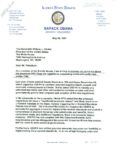
As a member of the Illinois Senate, I am writing to express my concerns about
the proposed EPA Clean Air regulations concerning ozone and particulate
matter (PM).
Last year, Illinois passed Senate Resolution 190 and House Resolution 95,
which urged the USEPA to consider potential negative health impacts and
economic consequences to Illinois. It also asked USEPA to identify any
unfunded mandates and other administrative burdens on state and local
governments prior to final proposal and adoption of the new regulations.
In its comments on the proposals, Illinois EPA stated that the proposed
regulations will have a "significant economic impact" and likely result in an
unfunded mandate on the State, thereby triggering the Unfunded Mandates
Reform Act of 1995. The Unfunded Mandates Act requires the USEPA to
estimate the aggregate economic impact of the revised standards and publish a
comprehensive analysis including anticipated costs and benefits, future
compliance costs, and additional regulatory, fiscal and economic impact
analyses. USEPA has not complied with the Unfunded Mandate Act's
requirements and has disregarded the economic impact on Illinois businesses,
and the costs to state and local governments.
Furthermore, USEPA has neither provided adequate resources nor flexibility in
implementing the proposed standards. In an era of tight budgets, state and
RECYCLED PAPER SOYBEAN INKS
JUN 4 1997
2.
local governments cannot afford the millions in additional spending required to
comply with the new regulations.
Even USEPA's own Clean Air Scientific Advisory Committee (CASAC) has
questioned the technical basis and scientific justification for the proposed
regulations. CASAC could not reach consensus on which new ozone and
particulate matter standards, if any, would result in improved public health. It
is contrary to sound public policy for USEPA to rush to implement these
regulations and potentially harm the economy of Illinois and our nation until the
scientific community has a better opportunity to reach consensus on the best
balance of costs and benefits.
In comments submitted to Congress, the City of Chicago opposes the proposed
regulations because they will cause significant job losses, negative public
health effects and more pollution, not less. The City believes the "EPA has
relied on a flawed definition of what it means to 'protect public health'. The
definition harms urban populations already at risk."
As the Chicago Tribune suggested in two recent editorials, "Upon review, the
EPA was wrong" (April 14, 1997) and "Of roaches, asthma and clean air" (May 19,
1997), "At the least, the EPA should back off on its determination to implement
the new regulations in July. It clearly needs more time to develop a strategy,
make sure it is the best strategy and get the science right."
Even other Departments and Agencies in your own Administration either
outright oppose or at least question the merits of the proposed regulations.
These include: US Department of Transportation, US Department of the
Treasury, US Department of Agriculture, US Department of Commerce, US
Department of Energy, US Small Business Administration, Office of
Management and Budget, President's Council on Economic Advisors, Office of
Science and Technology Policy.
Frank Kruesi, Assistant Secretary of Transportation, probably said it best. "It is
incomprehensible that the Administration would commit to new standards and
new efforts to meet such standards without a much greater understanding of
the problem and its solutions."
In light of all of the questions concerning the benefits of this regulation and
EPA's own estimates of $2-14 Billion in regulatory impact analysis. I
respectfully request that your Administration maintain current regulations until
further scientific research can be performed.
3.
Thank you for your attention to this critical matter.
Brad Sincerely, One
Barack Obama
Senator - 13th District
Collection WJC-WHORM
Records of the White House Office of Records Management (Clinton Administration)
1993 – 2001
Series
Subject Files on Federal Government Organizations
1993 – 2001