
Pages
(3)
Page 1
Page 2
Page 3
Transcription
[typed] The President February 6, 1975
Page Two
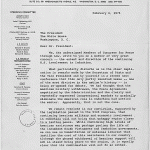
Another prolonged disagreement over events in Vietnam and our policy there may well lead to acrimonious accusations over who "lost" Indochina, reminiscent of the China debate over two decades ago. The result of that earlier experience was to freeze U.S. options in Asia for a quarter of century. We must at all costs avoid a repetition of such a struggle which would set the Congress against the Executive.
It is especially unfortunate that the internal debate over Indochina should resume at a time when we are confronted by so many pressing domestic and international problems. These problems do not have easy solutions. They require an extraordinary degree of accord between our two branches of government and among the industrialized and developing nations.
This is not the time for another divisive debate that can only impede the development of the cooperation so necessary in dealing with the complex problems of global inflation, domestic recession, and growing shortages of necessary raw materials. Instead, we need to work together.
We believe the time is now at hand when our government must make a decision, too long postponed at at tragically high cost to both the people of Indochina and to our own citizens as to how we will extricate ourselves from the situation in Southeast Asia once and for all.
We write to ask you and your most senior advisors to accept this expression of our views in a spirit of conciliation. We should get on with the important work ahead of us. Innovative leadership both from you and the Congress will be needed more than ever.
Accordingly, we are prepared for a serious, unemotional dialogue on the immediate problem of ending our involvement in Indochina responsibly and honorably. We are not prepared for it to continue indefinitely.
Sincerely,
(List of signatories follows on next page)
[circular stamp with text within] GERALD R. FORD LIBRARY
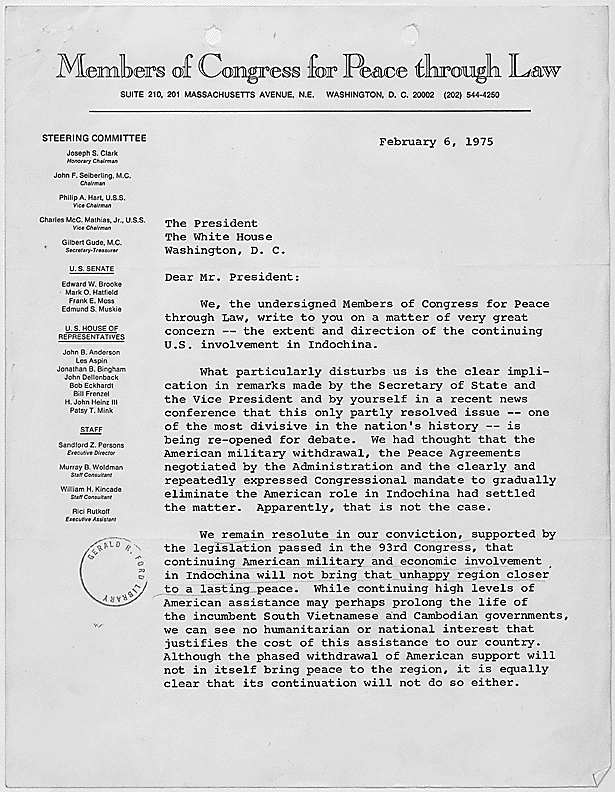
[printed letterhead] Members of Congress for Peace through Law
SUITE 210, 201 MASSACHUSETTS AVENUE, N.E. WASHINGTON, D. C. 20002 (202) 544-4250
[horizontal line across page]
[along the left margin]
STEERING COMMITTEE
Joseph S. Clark
[italics] Honorary Chairman [/italics]
John F. Seiberline, M.C.
[italics] Chairman [/italics]
Philip A. Hart, U.S.S.
[italics] Vice Chairman [/italics]
Charles McC. Mathias, Jr., U.S.S.
[italics] Vice Chairman [/italics]
Gilbert Gude, M.C.
[italics] Secretary-Treasurer [/italics]
[underline] U. S. SENATE [/underline]
Edward W. Brooke
Mark O. Hatfield
Frank E. Moss
Edmund S. Muskie
[underline] U. S. House of Representatives [/underline]
John B. Anderson
Les Aspin
Jonathan B. Bingham
John Dellenback
Bob Eckhardt
Bill Frenzel
H. John Heinz III
Patsy T. Mink
[underline] STAFF [/underline]
Sandford Z. Persons
[italics] Executive Director [/italics]
Murray B. Woldman
[italics] Staff Consultant [/italics]
William H. Kincade
[italics] Staff Consultant [/italics]
Rici Rutkoff
[italics] Executive Assistant [/italics]
[circular stamp with text within] GERALD R. FORD LIBRARY [/stamp]
[body of letter]
February 6, 1975
The President
The White House
Washington, D. C.
Dear Mr. President:
We, the undersigned Members of Congress for Peace through Law, write to you on a matter of very great concern -- the extent and direction of the continuing U.S. involvement in Indochina.
What particularly disturbs us is the clear implication in remarks made by the Secretary of State and the Vice President and by yourself in a recent news conference that this only partly resolved issue -- one of the most divisive in the nation's history -- is being re-opened for debate. We had thought that the American military withdrawal, the Peace Agreements negotiated by the Administration and the clearly and repeatedly expressed Congressional mandate to gradually eliminate the American role in Indochina had settled the matter. Apparently, that is not the case.
[handwritten underline] We remain resolute in our conviction, supported by the legislation passed in the 93rd Congress, that continuing American military and economic involvement in Indochina will not bring that unhappy region closer to a lasting peace. [/underline] While continuing high levels of American assistance may perhaps prolong the life of the incumbent South Vietnamese and Cambodian governments, we can see no humanitarian or national interest that justifies the cost of this assistance to our country. Although the phased withdrawal of American support will not in itself bring peace to the region, it is equally clear that it continuation will not do so either.
[typed] The President F[letters punched from page]ruary 6, 1975
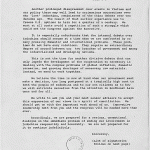
Page Three
[underline] SENATE [/underline]
Dick Clark [check mark] Mark O. Hatfield
[check mark] Abourezk [check mark]Hubert H. Humphrey
[check mark] Cranston [check mark]George S. McGovern
[check mark] A. Hart [check mark]Adiai E. Stevenson III
[check mark] Haskell [check mark]John V. Tunney
[check mark] D. Hathaway [check mark]Harrison Williams, Jr.
[underline] HOUSE OF REPRESENTATIVES [/underline]
[check mark] Bella Abzug [check mark] Edward I. Koch
[check mark] Thomas L. Ashley [check mark] Robert L. Leggett
[check mark] Les Aspin [check mark] Paul N. McCloskey, Jr.
[check mark] Herman Badillo [check mark] Mike McCormack
[check mark] Jonathan B. Bingham [check mark] Andrew Maguire
[check mark] Michael T. Blouin [check mark] Spark Matsunaga
[check mark] Edward P. Boland [check mark] Lloyd Meeds
[check mark] John Brademas [check mark]. Ralph H. Metcalfe
[check mark] George Brown, Jr. [check mark] Edward Mezvinsky
[check mark] Yvonne B. Burke [check mark] Parren Mitchell
[check mark] John L. Burton [check mark] John J. Moakley
M. Robert Carr [check mark] William Moorhead
[check mark] Silvio O. Conte [check mark] Charles A. Mosher
[check mark] John Conyers, Jr. [check mark] Gary A. Myers
[check mark] James C. Corman [check mark] Edward Pattison
[check mark] Ronald V. Dellums [check mark] Joel Pritchard
[check mark] Charles Diggs [check mark] Charles B. Rangel
[check mark] Robert F. Drinan [check mark] Thomas M. Rees
[check mark] Don Edwards [check mark] Henry S. Reuss
[check mark] Joshua Eilberg [check mark] Frederick W. Richmond
[check mark] William D. Ford [check mark] Donald Riegle, Jr.
[check mark] Donald M. Fraser [check mark] Peter W. Rodino, Jr.
[check mark] Bill Frenzel [check mark] Benjamin S. Rosenthal
[check mark] William J. Green [check mark] Edward Roybal
[check mark] Gilbert Gude [check mark] Fernand St. Germain
[check mark] James M. Hanley [check mark] Patricia Schroeder
[check mark] Thomas Harkin [check mark] John F. Seiberling
[check mark] Michael Harrington [check mark] Fortney H. Stark, Jr.
[check mark] Elizabeth Holtzman [check mark] Gerry Studds
[check mark] James Howard [check mark] James W. Symington
[check mark] Andrew Jacobs, Jr. [check mark] Frank Thompson
[check mark] Barbara Jordan [check mark] Morris K. Udall
[check mark] Robert Kastenmeier [check mark] Charles H. Wilson
[check mark] Martha Keys [check mark] Antonio B. Won Pat
cc: The Secretary of State
Collection GRF-0056
White House Central Files Subject Files (Ford Administration)
1974 – 1977
Series
White House Central Files Subject Files on Foreign Affairs
1974 – 1977
FileUnit
FO 3-2/CO 165 to CO 165-2: Mutual Security/Vietnam