
Pages
(1)
PDF
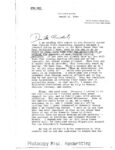
OCR Extracted Text
Auto-generated by the National Archives Catalog.
EYES ONLY
RICHARD NIXON
March 21, 1994
577 CHESTNUT RIDGE ROAD
WOODCLIFF LAKE, NEW JERSEY
Denn M.
I am sending this report to you directly rather
than through State Department channels because I
learned during my years in the White House that the
best decisions I made, such as the one to go to
China in 1972, were made over the objections of or
without the approval of most foreign service
officers. If you have not already done so, you will
find that foreign service officers are seldom
ignorant, but almost always arrogant. When they see
a report from an outsider, they invariably react by
saying, "We knew that. There's nothing new in it. If
Or, at the other extreme, "This is interesting, but
we want to study it"
...
which they proceed to do
until it is forgotten. I would urge you always to
remember that foreign service officers get to the
top by not getting into trouble. They are therefore
more interested in covering their asses than in
protecting yours. In that spirit, I submit the
following conclusions after my trip to Russia,
Ukraine, Germany, and London.
First, the good news. Everyone I talked to in
the four countries I visited spoke with great
respect for you, and in Kohl's case, with genuine
affection. Not one mentioned Whitewater. Some of
the America media tried to get me to make a
statement on it, but I turned them all off by
stating that I never commented on domestic issues
when I am travelling abroad. I went on to say that
what was most important is that we not allow that
issue or any other domestic issue to divert
attention from our major foreign policy priority --
the survival of political and economic freedom in
Russia. I emphasized that on this issue there
should still be continued strong bi-partisan support
for the President's leadership.
As one of Yeltsin's first supporters in this
country and as one who continues to admire him for
Photocopy Misc. Handwriting
his leadership in the past, I have reluctantly
concluded that his situation has rapidly
deteriorated since the elections in December, and
that the days of his unquestioned leadership of
Russia are numbered. Kohl is the only one I met who
disagrees with this view. This speaks more for
Kohl's loyalty to an old friend than it does to his
usually brilliant political judgment.
Since the December elections, Yeltsin is a
changed man. His drinking bouts are longer and his
periods of depression are more frequent. Most
troublesome, he can no longer deliver on his
commitments to you and other Western leaders in an
increasingly anti-American environment in the Duma
and in the country. I expected this among
opposition leaders like Zhirinovskiy, Rutskoi, and
Zuganov, but I found the same attitude among middle-
of-the-road and liberal supporters of Yeltsin's
economic and political reforms. He is still the
elected head of our most important strategic
partner. But those who rely on his commitments will
soon find that he no longer has the political
strength to deliver.
Even Pickering, who is one of our top-ranked
ambassadors, underestimates the danger. He told me,
for example, that John Major found that Yeltsin was
in good shape when he saw him on his visit to
Moscow. To paraphrase George Bush, this is not deep
doo-doo, it is bullshit. Major was deeply concerned
about Yeltsin's conduct during their meetings. All
of the British leaders that I talked to in London,
from the Chancellor of the Exchequer on down,
believe that Yeltsin has had it, and sharply
disagreed with me when I gave my own more optimistic
evaluation -- insisting that I was looking through
rose-tinted glasses.
A year ago, Kravchuk told me that Yeltsin was
better for Ukrainian-Russian relations than any of
his potential opponents. This is no longer true. I
asked him bluntly whether Yeltsin could survive. He
said categorically and quickly, "Nyet. " He
predicted he soon would be out of power. I asked
him, "How -- by coup or by election?" He said,
"Neither. The Russian power brokers will surround
him and elevate him into a highly ceremonial post as
the Tunisians did with Bourguiba." I asked him when
he had reached this conclusion. He replied, "Right
after the December elections." He said that he used
2.
PHOTOCOPY WJC HANDWRITING
to talk to Yeltsin on the phone a couple of times a
week. He has been unable to reach him at all on the
phone since the elections.
All this means not that you should discontinue
the positive "Boris-Bill relationship," which has
been widely reported in the media, but that you
recognize that Yeltsin plays an increasingly weak
hand and that it is necessary to reach out to others
who have some power now and may have all of the
power sooner than we might like.
Bush made a mistake in sticking too long to
Gorbachev because of his close personal
relationship. You must avoid making that same
mistake in your very good personal relationship with
Yeltsin.
Understandably, you might have reservations
about any criticism of your Administration in the
Wall Street Journal. However, the article on
foreign aid to which you referred in our telephone
conversation is unfortunately on target. The entire
foreign aid program to Russia is a mess. This
ranges from the IMF's stubbornness and stupidity in
continuing to treat Russia like Upper Volta (which
no longer exists, incidentally). American and
Russian businessmen are ripping off the aid programs
shamelessly. In the past two years, Russians have
sent over $25 billion to Switzerland and other safe
havens. This money will not come back until there
is a better climate for investment in Russia. The
quick answer from those like Jeffrey Sachs that what
is needed is an increase in government aid is
irrelevant. Politically, the overreaction to the
Ames case indicates that the Congress is looking for
any excuse to vote against Russian aid. This will
be doubly true during the election year. What is
needed is better targeting and better administering
of those programs we already have and an entirely
new approach with regard to investment from abroad.
As you know, China has by far the highest
growth rate of any major country in the world. This
has been accomplished with hardly any government
foreign aid whatsoever. We face the ironic fact
that a communist capitalist economy in China is more
attractive for foreign investment than a democratic
capitalist economy in Russia.
This brings me to a very painful
3.
PHOTOCOPY WJC HANDWRITING
recommendation. As I am sure you know, I share your
respect and affection for Strobe Talbott. This goes
back to the time when I totally supported his then
controversial view about Israeli-Arab relations. He
is an outstanding political officer. His strong
suit, however, is not economics. What we need now
is a new program, such as the one we had during the
Marshall Plan, where aid is administered by a top-
flight businessman reporting directly to the
President. Strobe has to be big enough to accept
this idea and not to insist that everything go
through him and his staff.
It has been my experience that foreign service
officers are very good on political issues but
economics is not their strong suit. Like most
politicians, they know very little about economics
and much of what they do know is wrong. I would
suggest a heavyweight like Dwayne Andreas, but he
would be rejected because of conflict of interest.
Another possibility might be Hank Greenberg, an
enormously successful international businessman and
financier who, incidentally, is not only very good
on Russia but is outstanding on China. What you
must avoid is a situation where some Congressional
committees begin holding hearings on the
Administration's foreign aid program. They will
bring out a lot of horror stories which will lead
Congress to cut the already inadequate amounts being
appropriated for aid. You should beat them to the
punch by naming a new administrator with
instructions to clean up the mess and to concentrate
not primarily on government-to-government aid but on
how Russia can --on a crash basis -- develop the
protections and incentives for private investments
from abroad, similar to those which have led to the
Chinese economic miracle.
As I am sure you agree after meeting with
Kravchuk, the situation in Ukraine is highly
explosive. If it is allowed to get out of control,
it will make Bosnia look like a PTA garden party.
Our emphasis has understandably been on the nuclear
weapons issue. We should be concentrating more on
what could lead to the use of arms rather than just
controlling their numbers. Some increase in
government aid, which you have already approved,
will be helpful. But like Russia, the major
challenge here is for the Ukrainian Parliament,
which is even worse than the Russian Duma, to
provide incentives for private investment. Ukraine
4.
PHOTOCOPY WJC HANDWRITING
is an enormously wealthy country and could take off.
The problem is illustrated by the fact that with all
of Russia's difficulties, thirty-five to forty
percent of the Russian economy has been privatized.
Only two to five percent of Ukraine's has been
privatized.
The political situation is unpredictable.
Kravchuk's approval numbers are far lower than
Yeltsin's, but he should never be underestimated
because he is probably the most skillful politician
in all of the former Soviet Union. He is unusually
honest for a politician! I do not refer to
financial honesty but to political honesty. When I
asked him in 1991, when he was still a Gorbachev-
supporting loyal communist, whether he could be
elected president, he said categorically "Nyet." He
says the same thing now. But he still has no one in
Ukraine who is even in his league.
Because of the importance of Ukraine, I
reluctantly urge that you immediately strengthen our
diplomatic representation in Kiev. I asked a top
American businessman, who is strongly for Ukraine
and pro-American, for his evaluation of our embassy.
He said, "piss-poor." With expletives deleted, I
would say that based on conversations I have had
with other businessmen that our representation is
pathetic. The embassy is understaffed and
inadequately led. One of the difficulties is that
our foreign service types love to be sent to cushy
posts in London or Paris or Rome where we have
overstaffed embassies. We have to get more of them
into combat zones like Ukraine, where even the
brightest and the best may fail but where we have to
give it our best try.
You will be urged to scatter the available aid
money all over the former Soviet Union. This would
be a mistake. You have very limited funds. All
the other nations in the near abroad are important.
But Ukraine is in a different class -- it is
indispensable.
There is still no one who is in Yeltsin's class
as a potential leader in Russia. But several have
the capability to be outstanding presidents or prime
ministers. The Prime Minister - Chernomyrdin;
Yavlinski, who next to Yeltsin is the most popular
politician in Russia; Shahrai, Minister of
Nationalities; and Shokhin, the Economics Minister -
PHOTOCOPY WJC HANDWRITING
all except for Chernomyrdin are in their thirties
or early forties, should be cultivated and others
like them evaluated and discreetly encouraged.
Your instincts in approving my decision to see
all the opposition leaders, including Zhirinovskiy
and Rutskoi, proved to be right. Zhirinovskiy is a
powerful political personality. I can best sum up
his political astuteness by observing that while
anti-Semitism for Hitler was a faith, for him it is
a tactic. This may make him even more dangerous.
However, when I asked Kravchuk whether he thought
Zhirinovskiy could be elected President, he flatly
said no. On the other hand, he said that "the
Zhirinovskiy phenomenon" could produce a credible
candidate for President one who did not have
Zhirinovskiy's baggage of being perceived as a total
opportunist and sometimes even as a clown. The
Russians are serious people. One of the reasons
Khrushchev was put on the shelf back in 1964 is that
the proud Russians became ashamed of his crude
antics at the U.N. and in other international
forums.
This brings me to the tactic I would urge that
we follow in dealing with Zhirinovskiy. Expose him
rather than suppress him. Let people see what a
fraud he is. And above all, divide his support
rather than unite it. Letting Rutskoi out of prison
actually helps Yeltsin and all the other responsible
leaders. He will cut sharply into Zhirinovskiy's
support. This will be particularly true among the
military, who Zhirinovskiy claims voted for him 90%.
Rutskoi will get over 50% of them as well as many of
Zhirinovskiy's other supporters who want to restore
the former Soviet empire. The third reactionary
force is the communist-agrarian coalition. Zuganov
is a tough-minded, able communist leader. He told
me that he did not want to go back to communism --
that "we cannot cross the same river twice. = That,
of course, is only for public consumption.
Communism has been completely discredited. If there
is one thing I would bet on at the present time, it
is that God is alive in Russia; communism is dead.
Our overall policy, therefore, should be to
keep the bad guys Zhirinovskiy, Rutskoi, and the
communists divided, and to try to get the good
guys Chernomyrdin, Yavlinski, Shahrai, Travkin
to coalesce if possible in a united front for
responsible reform.
6.
PHOTOCOPY WJC HANDWRITING
I had not met Kohl, and was enormously
impressed by him. I can see why you rate him as by
far the best leader in Europe. From our media, I
had the impression that he was a provincial clod. I
found that he exudes political strength and
charisma. Very few give him a chance to win. I
believe, however, if he is able to keep his party
together and if the opposition starts quarreling
among themselves as they usually do, he has a shot.
It is certainly in our interest that he survive.
In sum, political and economic freedom may
survive in Russia, even with our help. It will
certainly fail without our help. I wish you the
very best as you continue to provide the leadership
we need on the most important foreign policy issue
the nation will face for the balance of this
century.
Sincerely,
@
The Honorable William J. Clinton
The White House
Washington, D.C. 20500
7.
Photocopy Misc. Handwriting
Collection WJC-NSCNSA
Records of the National Security Council National Security Advisor (Clinton Administration)
1993 – 2001
Series
Anthony Lake's Files
1993 – 1997